
Background
House of Harlow is Nicole Richie’s luxury jewelry brand. Strong identity, devoted social audience, and a product line built around statement pieces with a $400+ average order value. Before the Black Friday engagement, Meta ads were running but had stalled at a sub-1x ROAS, Google had no coordinated promotional layer, and the email program was sending generically rather than to a sales calendar. The brand had goodwill and traffic. The paid engine and the lifecycle layer were not pulling in the same direction.
The Challenge
Three weeks until Black Friday. A baseline month where Meta produced $0.81 of revenue for every dollar spent. No unified offer running across paid and email. The biggest revenue window of the year was about to arrive, and the brand needed a coordinated plan that paired aggressive promotional cadence with premium positioning, so older inventory cleared at a discount and the newer collections and fine jewelry stayed protected at full price.
The Strategy
Noble Growth designed the Black Friday narrative as four discrete phases, each with its own promise, urgency hook, and creative slate. Every paid placement and every email send laid down on top of the same cadence and the same promo code, so a shopper saw the same story whether the ad caught them in Instagram, in a Google search, or in their inbox.
- Phase 01, Nov 24, Black Friday: 50% Off Select Styles. Open the sale on archive collections only. Newer collections and fine jewelry stay at full price. Clear framing of what’s included builds trust.
- Phase 02, Nov 26, Mid-week push: Up to 70% Off. Layer the 50% Black Friday discount onto pieces already marked down 20%. Same archive inventory, a fresh hook, a stronger urgency line for the holiday-party shopper.
- Phase 03, Nov 28, Restock pulse: New Styles Added. Mid-sale re-engagement. Additional archive pieces dropped into the edit at the same 50% off, refreshing the offer and giving repeat openers a reason to come back.
- Phase 04, Nov 30 to Dec 1, Cyber Monday: Last Chance Up to 70% Off. Close the sale strong. Scarcity-driven last-call across Meta, Google, and two final e-blasts. Sale ends at midnight, and stays ended, with no extensions.
One promo code carried every channel. Meta carried the brand storytelling at the top of the funnel. Google caught the demand that Meta created. Email reactivated the existing list. All three pointed at the same edit, used the same urgency, and converted on the same code, BF50, so attribution stayed clean and the customer experience stayed coherent.
Meta Ads: demand creation at the top of the funnel
Instagram-weighted placements served the four-phase creative slate. Top ads ran in the 3-4% CTR range against a Meta industry average closer to 1%. Many shoppers who first saw the offer on Instagram closed later via Google search, giving the campaign a clean one-two punch across channels.
Google Ads: demand capture at the bottom of the funnel
Branded search and the BF50 promo asset caught buyers in the high-intent moment. Over the window, Google delivered 534 clicks at a 13.55% CTR with 251 conversions, and the BF50 promo asset alone drove 79 conversions at a 44% conversion rate on $88 of spend.
Email: five sends on the same cadence
The five-send Klaviyo cadence mirrored the paid story phase for phase. Open rates held in the 24-26% range across the window, and every single send placed paying orders on top of strong email-driven traffic.
Premium positioning through a sale
The discipline that made the campaign work as much as the promo. Three rules held the line on brand value while the sale ran.
- Discount the archive, protect the new. Only older collections went into the sale. The newer collections and the fine jewelry stayed full price, kept their premium positioning, and still drove full-price orders during the same window from shoppers the campaign brought to the site.
- Be explicit about what’s included. Every ad, every email, and every landing module made the “select styles” framing clear. No bait-and-switch, no opaque “up to” claims without proof. Trust builds when the offer is clear.
- One sale a year. No promotional pulses before BFCM, no extensions or “we brought it back” sends after Cyber Monday closed. Customers learned the sale is a genuine annual moment, not a constant feature, which is why the urgency works.
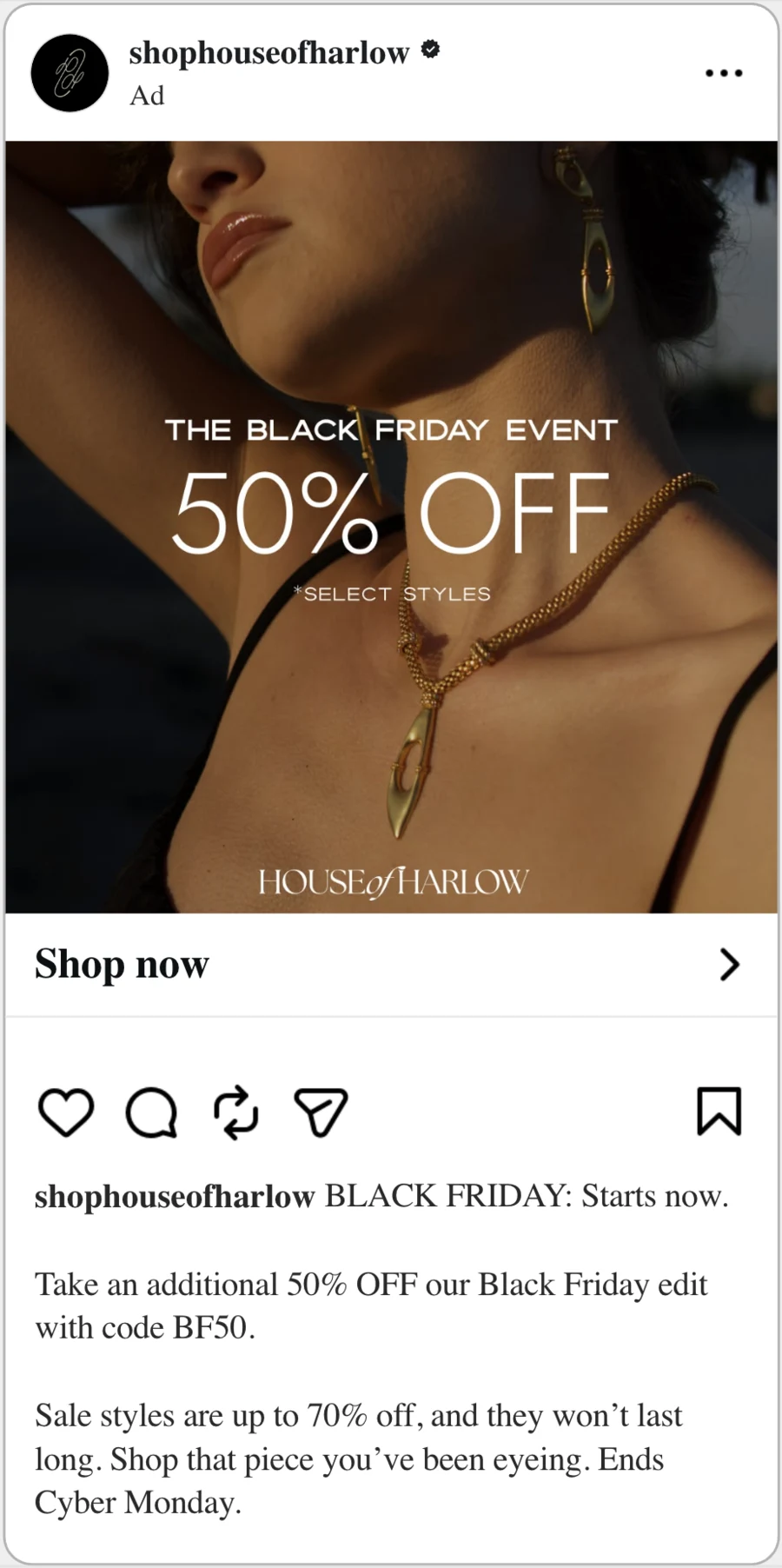
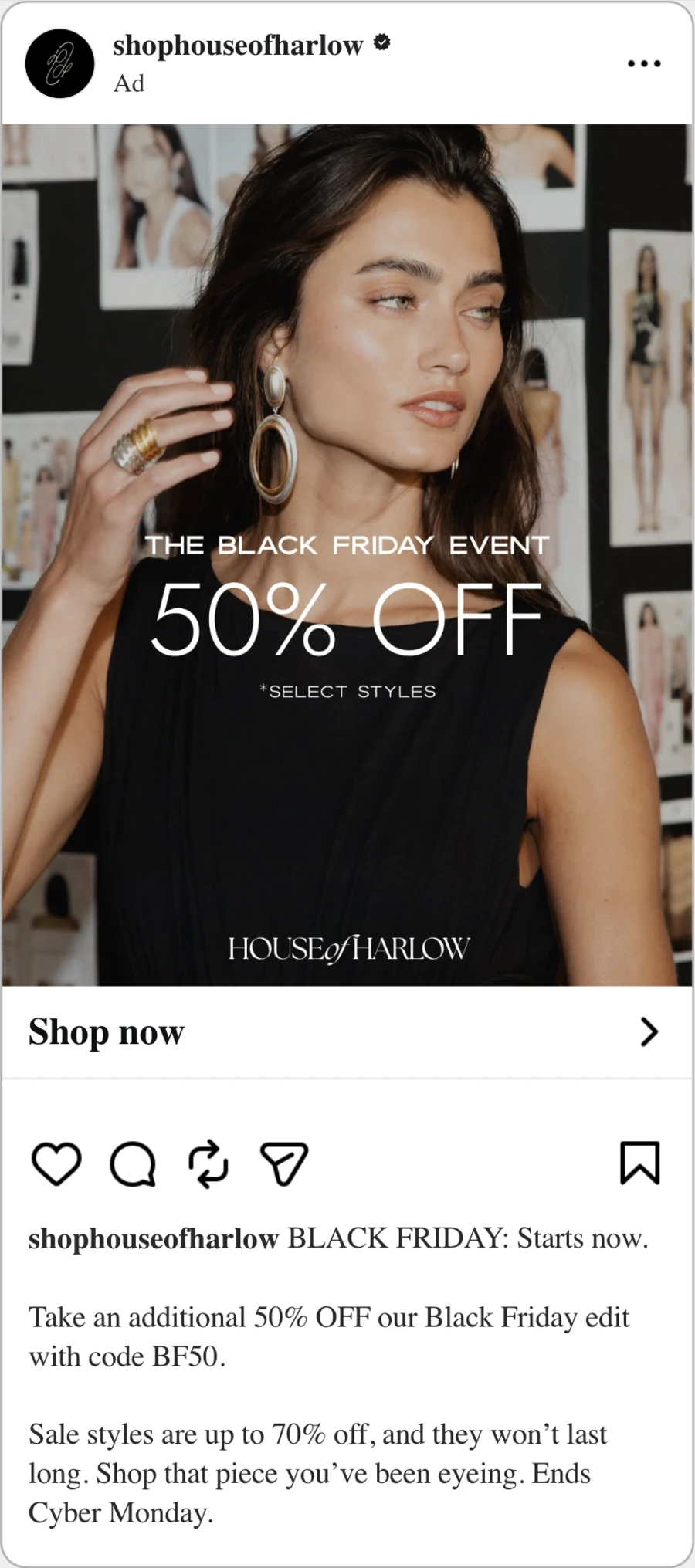
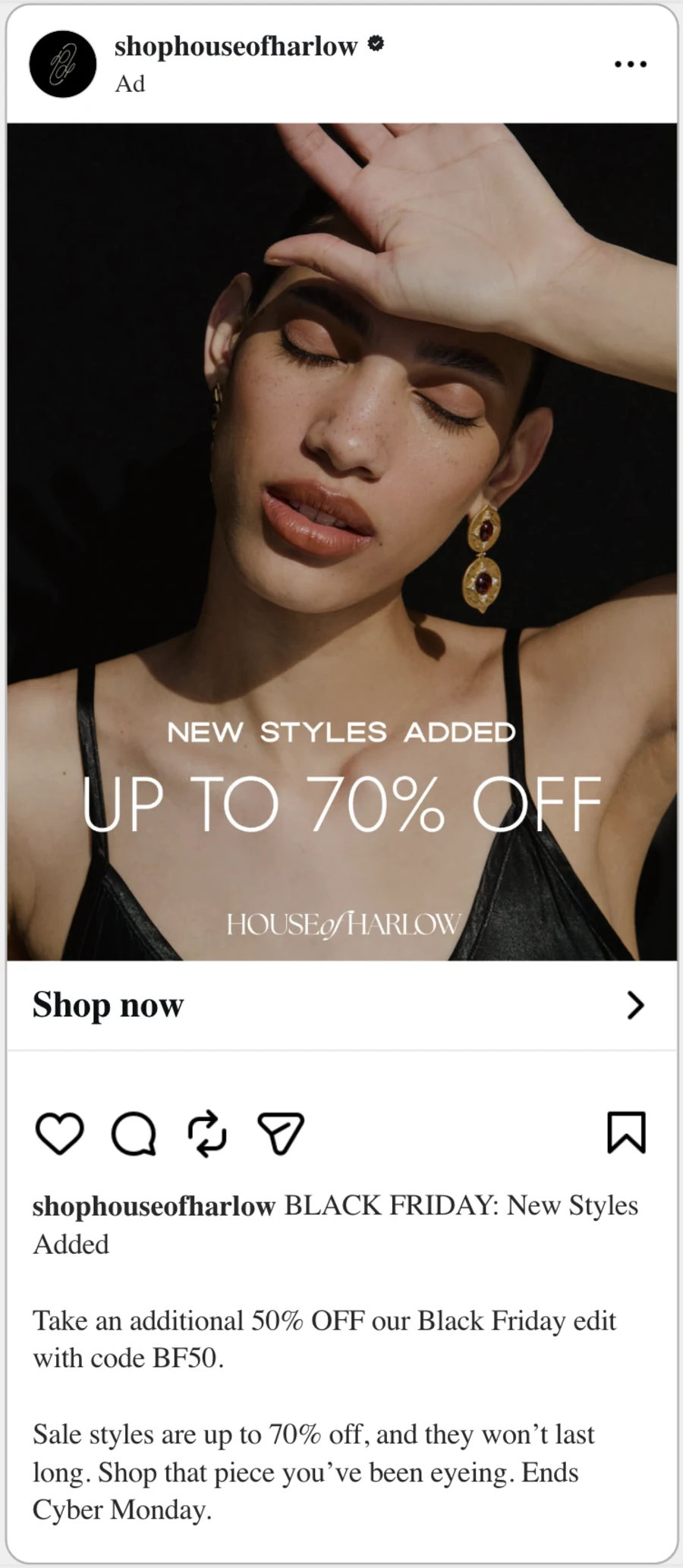
Three of the Meta ads from the Black Friday slate. Phase one and phase three creative shown on Instagram, the highest-converting placement for this audience.
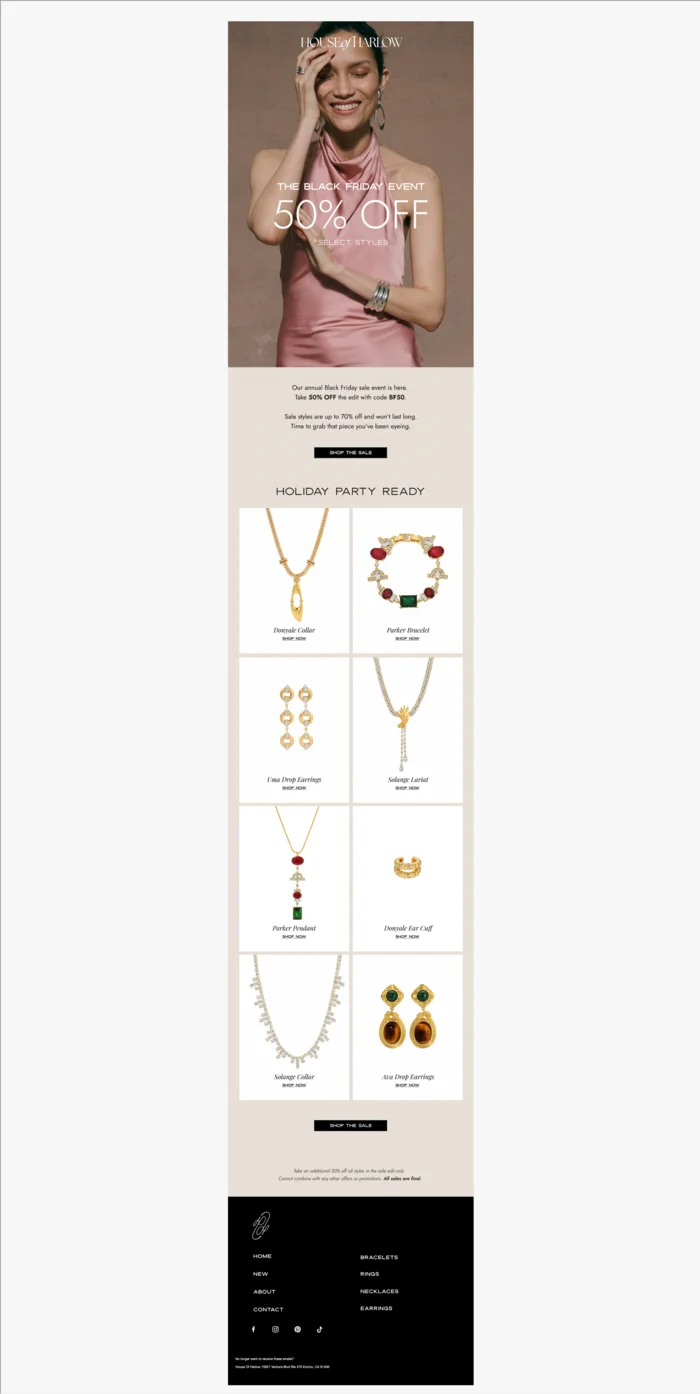
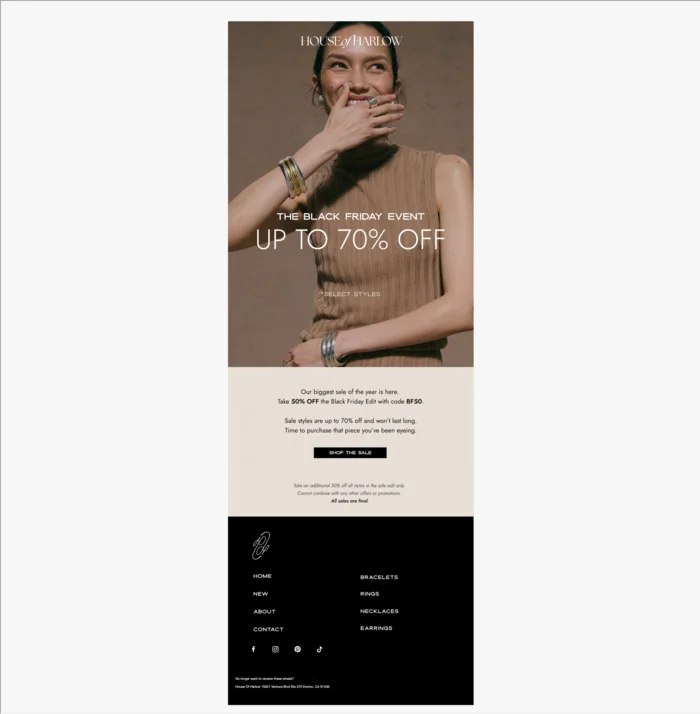
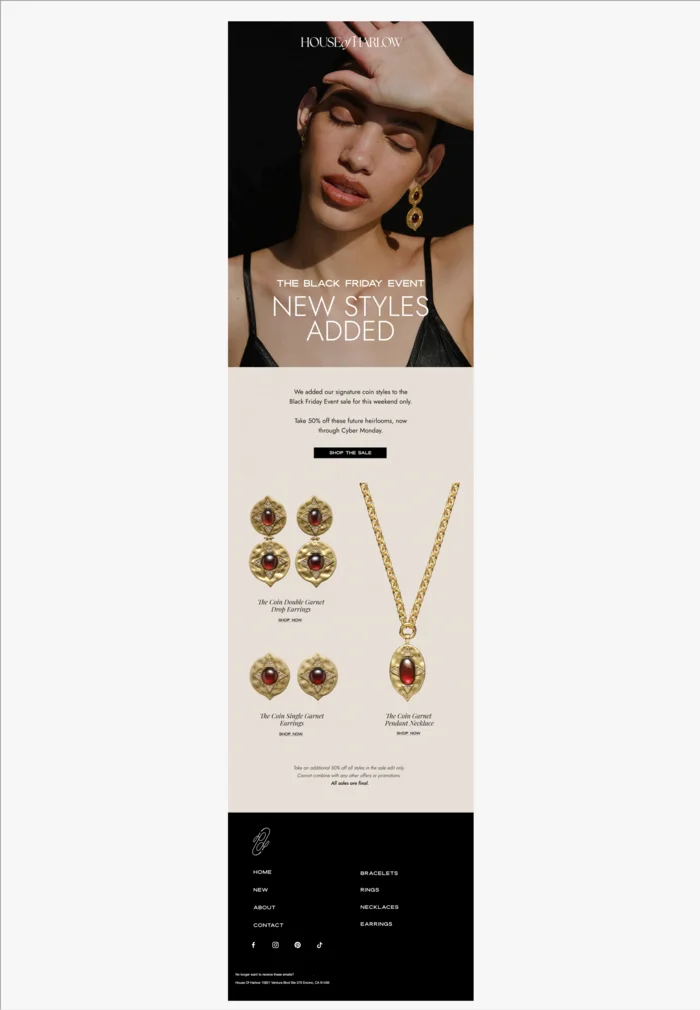
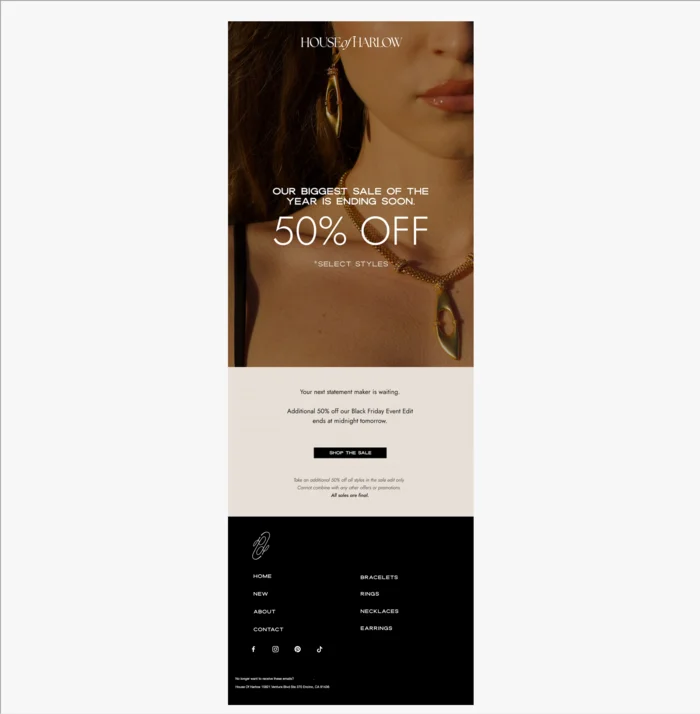
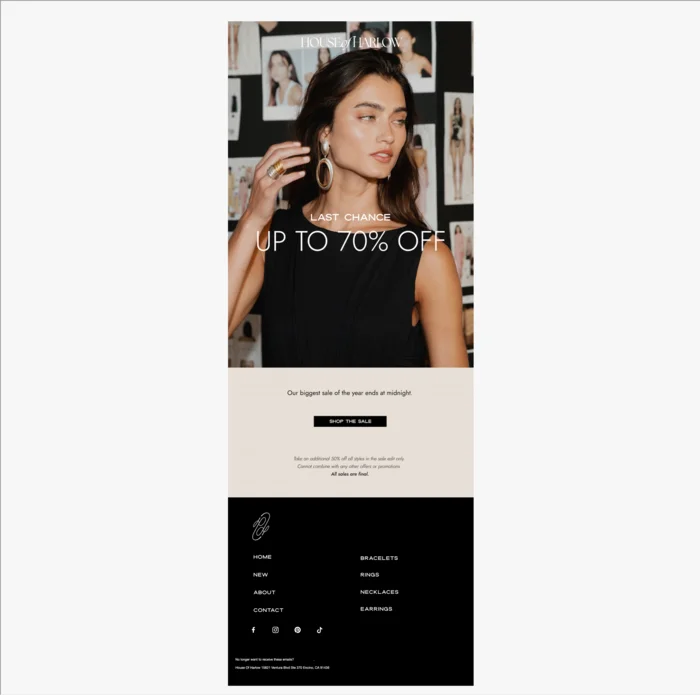
The five-send Klaviyo cadence, phase for phase with the paid story. Every send placed paying orders.
The Results
The coordinated plan landed before Black Friday and held through the recovery week. Meta climbed from a money-losing baseline to a 6x Black Friday week, with a peak day at nearly 26x ROAS and an 8x recovery week as retargeting and email compounded. The window closed with $33,353 in Shopify revenue across 81 orders, with a $412 average order value held steady across luxury statement pieces.
The climb was a staircase, not a spike, and it kept climbing after the sale closed:
| Window | Meta ROAS | Revenue per $1 of Meta spend |
|---|---|---|
| October baseline | 0.81x | $0.81 |
| Three-week lead-up | 4.33x | $4.33 |
| BFCM week | 6.00x | $6.00 |
| Recovery week | 8.38x | $8.38 |
Same account, same product line. The peak day reached $25.94 per dollar spent. Window: November 1 to December 8, 2025. Baseline: October 1 to October 31, 2025.
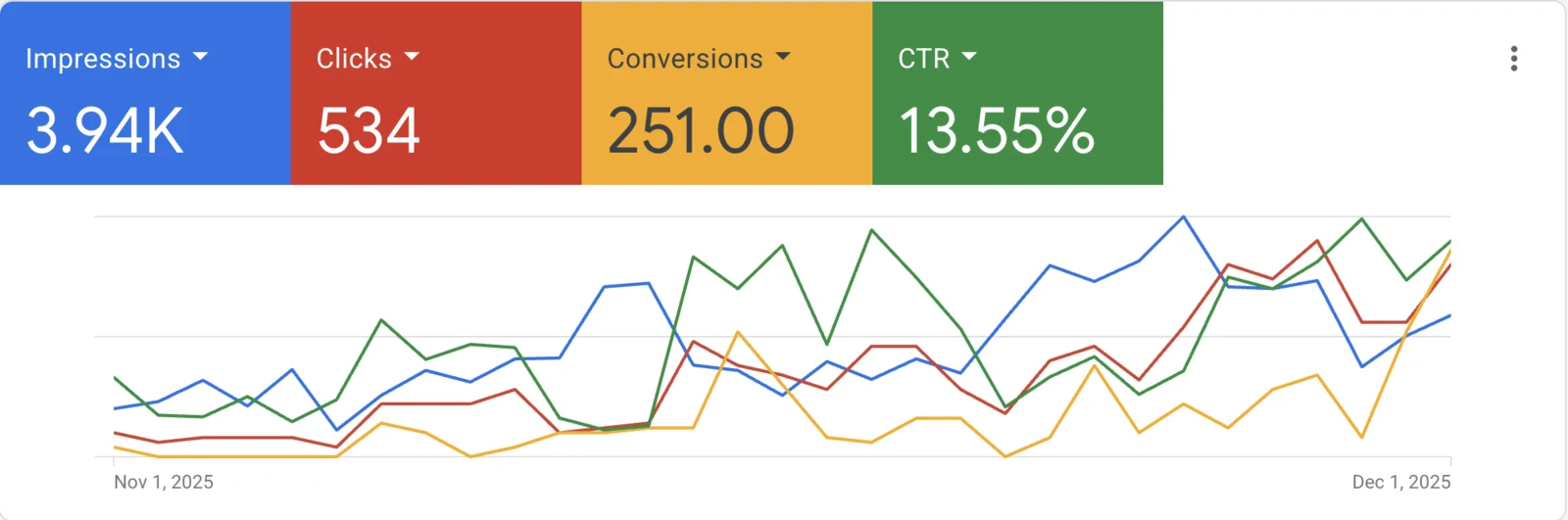
Google Ads, Nov 1 to Dec 1, 2025. 3.94K impressions · 534 clicks · 251 conversions · 13.55% CTR. Conversion volume climbs across the four-phase window. The shared BF50 promo asset drove 178 clicks and 79 conversions at a 44.38% conversion rate and $1.12 cost per conversion on $88.41 of spend.
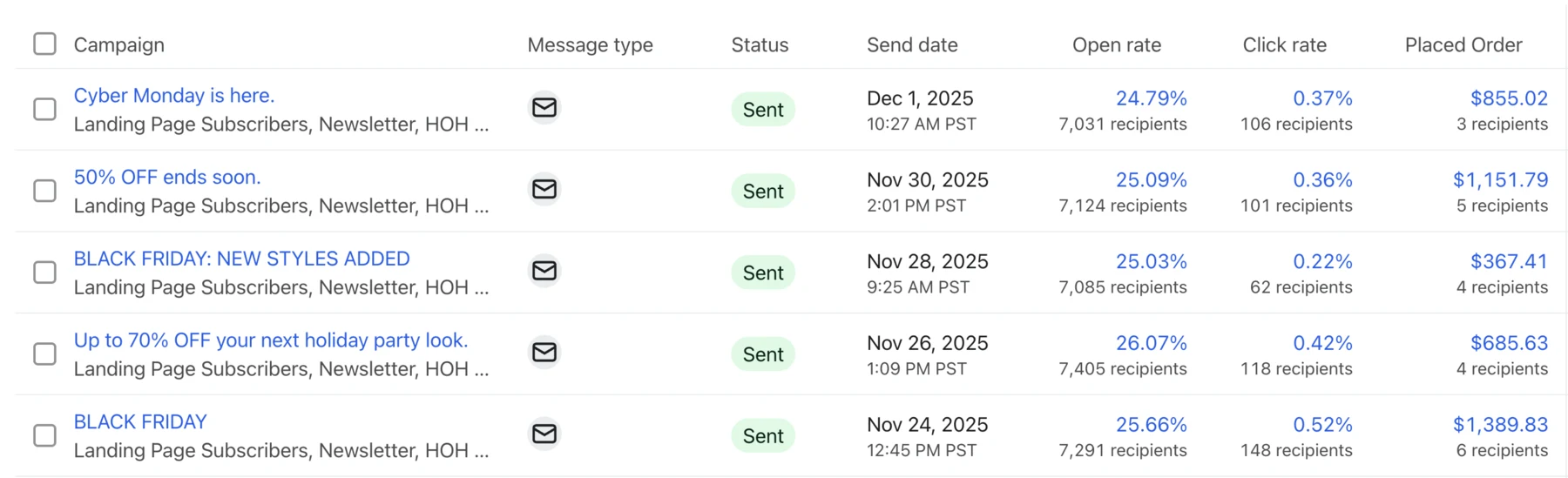
Klaviyo campaign report. Every send placed orders, open rates held 24-26% across the cadence.
“We have absolutely adored you on this side of the brand.”
Why It Works for Any Brand
The same playbook applies to any DTC brand running a major promotional window across paid and lifecycle channels:
- Plan the cadence in phases, not blasts. Each phase needs its own promise and urgency hook. Four phases keep the offer fresh for repeat openers without retraining customers to expect the sale every week.
- One promo code, every channel. Meta creates demand, Google catches it, email reactivates the list. Sharing a code keeps the story coherent and makes the attribution legible in Shopify.
- Protect what you sell at full price. Discount only the inventory you actually want to clear. Keep newer and premium lines out of the sale. They sell at full price during the same window from the traffic the sale drives.
- One sale a year. Customers can only trust scarcity when the brand is disciplined enough to mean it. No mid-month pulses, no extensions.
Who Did What
What we did
- Designed the four-phase Black Friday narrative and the single BF50 promo code across every channel.
- Ran Meta Ads for demand creation, with the top ads in the 3-4% CTR range.
- Ran Google Ads for demand capture: 534 clicks, 251 conversions, and the BF50 promo asset at a 44% conversion rate.
- Built and sent the five-send Klaviyo cadence, phase for phase with the paid story.
What the client did
- Kept the discount on archive collections only and held newer collections and fine jewelry at full price.
- Held to one sale a year: no pulses before Black Friday, no extensions after Cyber Monday.
- Brought the Shopify storefront, the Klaviyo list, and a devoted social audience the campaign could work with.
Conclusion
House of Harlow’s Black Friday closed with a 6x Meta ROAS week, an 8x recovery week, 251 Google conversions, and a five-send email cadence that placed paying orders on every campaign, all running off one promo code, four creative phases, and a brand that stayed premium through every minute of the sale. The same coordinated playbook of phased cadence, multi-channel attribution discipline, and premium positioning under promotional pressure is exactly what Noble Growth brings to every brand we partner with.